Is Voice the Future of Typing?
Speaking is about 4x faster than typing. As keyboard skills decline and voice recognition improves, we're witnessing a fundamental shift in how humans interact with computers.

The Unnatural Act of Typing
Watch someone think during a conversation. When asked a difficult question, they instinctively look away: up to the right, down to the left, anywhere but at the person speaking. This isn't rudeness. It's cognitive load management.
Research from Kyoto University found that maintaining eye contact disrupts verbal processing because "eye contact and verbal processing share cognitive resources." Studies on gaze aversion during memory retrieval show that people look away early in the thinking process (median 1.09 seconds) to reduce cognitive load from processing external visual stimuli. When your brain needs maximum capacity for thinking, it automatically removes visual input (faces, movement, environmental stimuli) to free neural resources for the task at hand.
This same principle explains why typing feels exhausting while speaking feels natural. Typing forces your brain to manage multiple simultaneous loads: keyboard layout memory, grammar rules, sentence structure, motor coordination for finger placement, visual tracking of cursor position, and the actual ideas you're trying to express. Speaking eliminates most of this overhead. You think, you speak. No intermediary translation layer consuming cognitive energy.
Evolution never prepared humans to type. We didn't develop neural pathways optimized for QWERTY layouts or muscle memory for Ctrl+C. Biology gave us speech, a 300,000-year-old technology refined through natural selection. Typing is a 150-year-old workaround we invented because written communication became necessary for information transmission at scale.
The Speed and Accuracy Gap
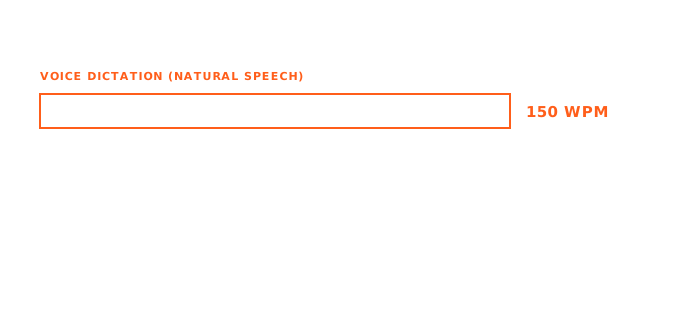
Here's the part people get wrong. You'll see claims that speech runs at "39 bits per second" while typing crawls at "6," so speaking must be six times faster. That mixes up two different things. The Science Advances study did find human speech packs information into the acoustic signal at a remarkably steady ~39 bits per second across every language tested - but that's the signal rate, how much redundancy gets stuffed into the sound wave. It is not how fast you think.
Your conscious output is the real bottleneck, and it sits at roughly 10 bits per second whether you speak or type. Skilled typists and fluent speakers hit the same cognitive wall. The difference is the pipe: speech is simply a wider, lower-friction channel for getting those 10 bits per second out of your head. You don't think faster when you talk - you spend less of your brain on the mechanics of getting it down.
Measure it in words, which is what actually matters for work, and the gap is honest and large. When you're composing original content rather than transcribing, typing by hand averages just 19 words per minute against around 150 for natural speech. Even against everyday typing at 38-40 WPM, speaking lands at roughly 4x faster when both involve active thinking - no made-up bit rates required.
The word-per-minute measurements confirm this gap. Stanford University's HCI research found speech input averaging 161 words per minute for English, compared to 38-40 WPM for average typing. Professional typists reach 65-75 WPM. Even exceptional typists rarely exceed 120 WPM. Meanwhile, conversational speech operates at 150-160 WPM without training. Some speakers comfortably reach 180-190 WPM.
The accuracy advantage amplifies the speed difference. The Stanford study found speech recognition produced 20.4% fewer errors than keyboard typing for English, and 63.4% fewer errors for Mandarin. The technology that was supposedly error-prone and unreliable now outperforms the method we've relied on for generations.
For knowledge workers who produce 10,000-50,000 words weekly, this compounds. At roughly 4x, the 4+ hours it takes to type 10,000 words collapses to about one hour spoken - and that's before counting the cognitive fatigue you avoid by dropping the typing overhead.
Why People Hate Writing But Love Meetings

Every organization struggles with the same pattern: someone proposes writing a document to avoid a meeting, and the team chooses the meeting anyway. Not because they enjoy meetings (most people despise unnecessary meetings) but because producing written communication costs more cognitive energy than speaking.
Writing a clear, structured document that ten people will read and understand identically requires intense mental effort: organizing thoughts hierarchically, choosing precise language, anticipating misinterpretation, maintaining logical flow across paragraphs. Speaking the same information in a meeting costs less. You explain, watch for confused faces, clarify in real-time, gauge comprehension through body language. The communication is less precise, but the energy expenditure is lower.
This creates a paradox: text is superior for information consumption but inferior for information production. Ten people reading the same document will understand it more consistently than ten people hearing the same verbal explanation. Text enables asynchronous communication, permanent reference, and precise language. But producing that text is expensive enough that people actively avoid it, choosing synchronous meetings despite the calendar chaos and scheduling overhead.
The gap between "best format for conveying information" and "easiest format for creating information" has shaped workplace communication for decades. Until now.
What the Younger Generations Already Know
Generation Z isn't learning to type. High school typing class enrollment dropped from 44% in 2000 to 2.5% in 2019. Nearly 40% of student work now arrives from handheld devices using voice input or touchscreen typing.
Generation Alpha (born 2010-2024, now entering their teenage years) takes this further. Research describes them as "Voice Natives" who grew up with voice assistants, tablets, and smart speakers from infancy. While Gen Z transitioned from keyboards to touchscreens, Gen Alpha never developed keyboard muscle memory in the first place. Studies show Gen Alpha prefers voice commands and audio content, with audio consumption increasing 10% compared to previous generations. Where millennials preferred written emails and Gen Z used text messages, Gen Alpha defaults to voice messages and voice-activated interfaces.
This isn't laziness or declining standards. It's rational adaptation to available technology. Touchscreens are intuitive: press the thing you want. No memorization of key positions, no training period to achieve basic proficiency. Voice input is even simpler: speak naturally, get text. The generations growing up with high-quality voice recognition see keyboards the way millennials saw fax machines, outdated technology that older people still use because they learned it first.
Research on Gen Z's interaction with voice AI confirms this preference isn't superficial. Studies show they value "the human experience of communicating with their devices" and prefer "navigating their everyday with voice and without textboxes and keyboards." When given the choice between typing a search query and speaking it, younger users choose voice not occasionally as a novelty, but as their default input method.
The implications extend beyond personal preference. Two generations are entering adulthood and the workforce with minimal keyboard proficiency and strong voice-first habits. Organizations will adapt. The technology they use for communication, documentation, and knowledge work will shift to match their interaction patterns. Voice-first interfaces won't be an accessibility feature or alternative input method. They'll be the primary interface.
The Missing Piece: Structure
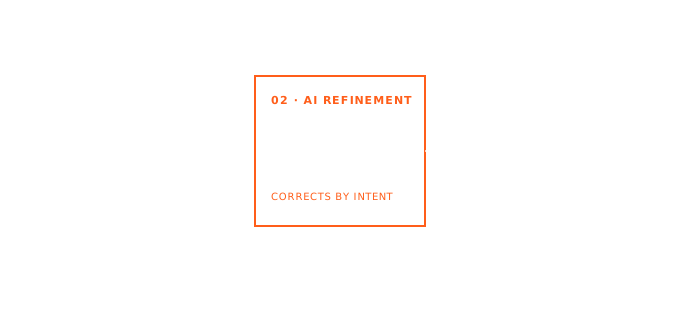
The traditional objection to voice input acknowledges the speed advantage but questions output quality: "Speaking produces unstructured rambling. Written communication requires organization and precision that voice can't provide."
This objection was valid in 2015. It's obsolete in 2025.
Large language models solved the structure problem. When you speak for 60 seconds about three unrelated topics in random order, modern AI can:
- Identify distinct ideas and separate them into logical paragraphs
- Add appropriate transitions between concepts
- Correct grammar and punctuation based on intent, not just transcription
- Adjust formality level for context (Slack message vs. client email)
- Restructure sentences for readability without changing meaning
The output isn't transcription. It's transformation. You produce unstructured thought at 160 WPM. The AI produces structured text at professional quality. The cognitive load of organization and formatting happens in the model, not in your brain.
This changes the calculation entirely. Previously, voice input traded structure for speed. You got text faster but had to edit heavily. Now, voice input with AI enhancement produces better initial drafts than most people type manually, in one-third the time, with less mental effort.
The asymmetry between text consumption and text production disappears. Text remains superior for conveying information precisely to multiple readers. But producing that text no longer requires the cognitive overhead of typing, formatting, and structural organization. You speak, the AI structures, the reader receives quality text.
What Replaces the Keyboard
The 10-20 year outlook for knowledge work input methods:
Voice becomes dominant for text generation. Not universal. Code editors and spreadsheets will retain keyboard interfaces where precise character-by-character control matters. But for the 80% of text creation that involves natural language (emails, documentation, reports, messages), voice input with AI structuring will become the default. Typing will persist as a fallback for situations where speaking is impractical (open offices, late-night work) or where manual editing provides more control than voice commands.
Touchscreens become the primary interaction interface for command and control. Visual, direct manipulation of UI elements requires less cognitive overhead than remembering keyboard shortcuts. The efficiency loss from removing hands from home row is offset by the cognitive efficiency of "see it, touch it" versus "remember the command, execute the key sequence."
Neurointerfaces remain 10-20 years from mass adoption. Current brain-computer interfaces require surgical implantation, work only for specific use cases, and cost hundreds of thousands of dollars. Predicting they'll become consumer products requires assuming massive breakthroughs in non-invasive sensing, signal processing, and brain-pattern decoding. Possible, but not imminent enough to plan for.
The optimal interface for the next decade: voice input + LLM processing + structured output. You speak naturally, expressing ideas as they form. The model handles transcription, grammar, structure, and formatting. The result appears as professional text ready for use. No keyboard overhead, no manual formatting, no mental energy spent on presentation instead of ideas.
The Biological Inevitability
Your brain operates on approximately 20 watts, roughly the power consumption of a dim light bulb. Despite this modest energy budget, the brain consumes 20% of your body's total energy at rest. Evolution optimized ruthlessly for energy efficiency. Any behavior that reduces cognitive load while accomplishing the same goal will win.
Typing requires cognitive resources for motor coordination, visual tracking, keyboard layout recall, and grammar rules, in addition to the actual thinking required for communication. Speaking requires only the thinking. The brain's energy accounting is straightforward: speaking costs less, therefore speaking wins.
This isn't a preference or a trend. It's biological inevitability. Once the technology exists to convert speech into quality written communication (it does), and once that technology becomes accessible and reliable (it is), human behavior will shift to match the lower-energy pathway. Not because people are lazy, but because the brain is optimized over hundreds of thousands of years to conserve cognitive resources.
The future isn't keyboards disappearing entirely. It's keyboards becoming specialized tools for specific tasks, while voice becomes the default input method for natural language. We're already seeing this transition in younger generations who never developed keyboard muscle memory because they never needed to.
The question isn't whether voice will replace typing for most text creation. The question is how quickly organizations, software interfaces, and workplace norms will adapt to acknowledge what's already happening.
What This Means for You
If you're reading this on a keyboard-equipped device, you grew up typing. Switching to voice input feels unnatural not because it's harder, but because you've invested thousands of hours building typing proficiency. The sunk cost is real.
Try this: dictate your next long email instead of typing it. Not as a transcription exercise where you carefully enunciate punctuation marks, but as natural speech explaining what you want to communicate. Use AI to structure the output. Compare the time spent and mental energy required.
The experience will feel uncomfortable at first. You'll want to edit while speaking. You'll catch yourself typing corrections instead of speaking them. This discomfort isn't evidence that voice input is inferior. It's evidence that you're skilled at typing and unskilled at dictation.
Give your brain permission to use the lower-energy pathway. The keyboard will remain available for the tasks where it's genuinely superior. But for the bulk of text creation (the emails, documents, messages, and notes that fill your workday) voice input backed by AI structuring is already faster, more accurate, and less cognitively demanding than typing.
For developers already commanding AI daily, voice input removes the prompt typing bottleneck entirely. The cognitive benefits of thinking out loud combine with the context richness of spoken language to create a workflow that's objectively faster and less fatiguing than typing.
Your brain already knows this. That's why it's so easy to speak and so exhausting to write. The technology finally caught up to what biology was telling us all along.