Cognitive Offloading: How Voice Liberates Your Working Memory
Discover why externalizing information through voice reduces mental load, prevents cognitive overload, and lets you focus on what actually matters.
Cognitive Offloading and the Working Memory Bottleneck
Cognitive offloading means moving information out of your head into an external system so working memory stays free for the task in front of you. Voice is the lowest-friction offload when your hands are on code or your eyes are on a doc.
With AICHE, the pattern is: press ⌃+⌥+R (Mac) or Ctrl+Alt+R (Windows/Linux), speak the thought before you switch apps, press again. The note lands in history (Work, Ideas, Life, or Misc) or at the cursor in whatever field had focus. You return to the primary task without holding the reminder in working memory.
Working memory is the mental workspace where you hold information while using it. Research on chunking, task switching, and external memory suggests most people actively juggle about 3-4 discrete items on complex work, not the old "magical seven." Prospective memory (remembering to do something later) competes for the same limited capacity.
When you exceed that limit, you forget things, make mistakes, and feel mentally exhausted. That is biology, not poor focus. Your brain runs on roughly 20 watts. Maintaining items in working memory costs energy evolution never optimized for ten parallel reminders.
The Hidden Cost of Internal Memory
Most knowledge workers try to solve this problem the hard way: by trying harder. Write better notes. Concentrate more. Develop better memory. But this is fighting biology. The real solution is to stop storing information in your brain.
This is where cognitive offloading enters - a concept from cognitive psychology that's straightforward but powerful: move information out of your head and into an external system. Let something else hold it. Your brain becomes free to focus on actual thinking instead of maintenance.
Writing does this. When you write something down, your working memory stops having to hold it. That's why to-do lists work. That's why keeping a notebook prevents you from forgetting details. You're not just creating a record; you're freeing up mental capacity.
But writing has friction. You have to stop what you're doing, find a device, open an app, type, remember the exact phrasing. By the time you're done, the cognitive offloading has consumed enough mental effort that it doesn't feel worth it for small pieces of information. So you try to hold it in your head instead. Your working memory becomes congested.
Voice bypasses this friction almost entirely.
Why Voice Is Brain-Friendly
Speaking requires no preparation, no interface navigation, no transcription burden. You're already wired to speak - it's automatic, requiring minimal conscious effort. Humans have been speaking for 300,000 years. We've been typing for 150. Your brain is optimized for speech in ways it will never be for keyboards.
Research confirms this. When comparing voice input to text input for the same task, voice produces lower cognitive load. You're engaging the same language production systems, but not the additional cognitive overhead of motor planning (finger positioning, key pressing, visual tracking of text as you type), spatial reasoning (where is the right key), and formatting concerns (capitalization, punctuation, backspace logic).
This neurological reality explains why voice assistants feel less exhausting than typing, even though both produce text. When you use your voice, more of your brain's energy is available for the actual thinking, while less is consumed by the interface mechanics.
Cognitive Offloading in Action
Here's what happens in a typical knowledge worker's morning:
You're in the middle of focused work on your main project. Suddenly, you remember: you need to email your boss by 3 PM. Without voice, you have two bad options:
Option A (context switch): Stop your main work, open email, draft the message, send it. Research on multitasking ties task switching to large switch costs: shelve the current context, load the new one, rebuild working memory, then switch back later.
Option B (mental juggling): Keep the reminder in your head while you work. Working memory now holds two active items: the main project and the pending email. Attention splits even though you never left the editor.
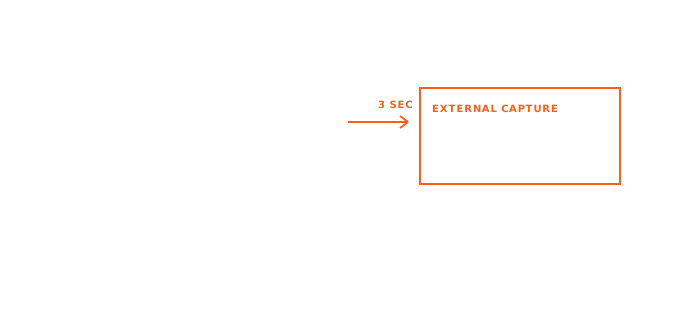
Option with voice: You speak a single sentence: "Remind me to email my boss at 2:30." This takes 3 seconds. Your working memory registers: the information has left your brain and been captured by an external system. Your attention returns fully to the main work. The cognitive cost is minimal - no context switch, no mental burden, just quick externalization.
The email will still get done. But your primary work doesn't suffer because you maintained full focus on it.
The Scale of Liberation
This advantage multiplies across a day. One interruption handled via voice might save 20% of the switch costs. But a typical knowledge worker manages dozens of such side tasks daily. Each one represents a small cognitive tax if it interrupts flow, or a small working memory burden if you try to juggle it mentally.
Add these up across 8 hours, and the cumulative effect is substantial. Your mental energy - the 20 watts you started with - gets spent on actual thinking instead of on task management overhead.
This is especially critical for complex work: coding, writing, analysis, problem-solving. These tasks require your working memory to be engaged with the problem itself, not partially allocated to remembering that you need to respond to a Slack message later. When you offload side tasks to voice, you reclaim that working memory for the work that actually matters.
Research bears this out. A 2020 study examining virtual assistants and cognitive load found that participants who could use voice commands to handle secondary tasks showed measurably lower cognitive load and performed measurably better on their primary task compared to participants who had to handle everything manually.
Hands-Free, Eyes-Free Cognition
There's another dimension to voice offloading: it's the only interface that works when your hands and eyes are occupied.
Imagine you're in your kitchen, chopping vegetables, and you think of three grocery items you need. With keyboard or pen, you're stuck - you can't safely write while cooking, and stopping to do so breaks your workflow. With voice, you speak the items into a note app without stopping. Your attention stays on the knife and the cutting board. You didn't interrupt your current task; you just externalized a thought.
The same applies to driving, exercising, walking between meetings, or any context where hands and eyes are allocated elsewhere. These aren't frivolous moments - for many people, these are prime thinking times. And being able to capture and offload thoughts during these moments means they don't persist in working memory, competing with your actual work for mental resources.
The Evolutionary Logic
Your brain is optimized to offload. Children do this naturally - they externalize thinking through speech, narrating their actions ("Now I put this here..."). This externalizes cognition helps them develop. Adults often suppress this, viewing thinking aloud as odd or immature. But the brain hasn't changed since childhood. Externalizing still offloads cognitive load. Speaking still clarifies thinking.
The reason is simple: your brain evolved to be social. Externalizing thoughts through speech was the original human technology. Our brains developed language not primarily for storing information (we use our environment and our social groups for that), but for externalizing thinking through conversation. When you use voice to offload, you're working with your brain's native modality, not fighting against its design.
Practical Offloading: The Brain-Dump Exercise
Try this for one week: whenever you feel overwhelmed by mental clutter - too many things to remember, too many side tasks, too many pending items - take 2 minutes and do a voice brain-dump.
Find a quiet place. Open a voice notes app (most phones have this built-in). Speak everything cluttering your mind: "I need to respond to three emails. I promised Sarah I'd send her that article. I'm worried I forgot to set the alarm. I need to review the proposal by Wednesday. I keep thinking about the bug in the payment system."
Don't organize it. Don't prioritize. Just externalize it. Get it out of your head and into the app.
Most people report that after a voice brain-dump, their mind feels measurably clearer. The cluttering items are still there - they haven't disappeared. But they're not in your working memory anymore. They're stored externally. Your brain, freed from the burden of maintaining them, reclaims that cognitive capacity for actual focus.
This is cognitive offloading in its simplest form. And it only works if you trust the system. If you voice-dump but then worry you'll forget where you put the notes, the offloading fails - the items are still mentally burdening you. But if you trust the system to preserve the information, the relief is real and measurable.
Why This Matters for Your Work
For people working with complex thinking - developers writing code, writers drafting complex arguments, analysts working through data - the freed working memory is existential.
Every bit of mental capacity you reclaim by offloading small distractions is capacity you can dedicate to the problem itself. And complex problems demand all of your working memory. They demand that 3-4 item limit be entirely devoted to the problem, not split between the problem and a list of pending tasks, reminders, and interruptions.
Voice tools are uniquely positioned to enable this because they're the only interface that doesn't require context switching or physical interruption. And context-switching is the enemy of deep work.
Your brain didn't evolve to juggle multiple active items. It evolved to focus intensely on one thing while externalizing secondary information through speech. When you align your tools with that design - when you use voice to offload what isn't the primary task - you stop fighting biology and start working with it.
The working memory limit you can't overcome becomes irrelevant when you're not trying to overcome it. Instead, you're using voice to work around it. And the work itself - the thinking that requires all of your cognitive resources - becomes clearer, deeper, and more focused.
Your brain has already told you what it needs. You're just finally listening.